Sunday, January 25, 2015

A January ride in DC


In January 2014, I was in Washington DC for a conference and took the opportunity to take Capital Bikeshare for a spin.  It was actually the most convenient way to go between the conference hotels.  With 2500 bikes and 300 stations, it is more connected and expansive system than Toronto's 800 bikes and 80 stations.  Check out Capital Bikeshare's data page with an impressive performance metrics dashboard.


Here's a look at some of the DC sights and infrastructure from my self-guided tour.

Bike box to get in position ahead of the queue:

Sharrow intersection crossing along a two-way cycletrack:

Bollards and parked cars provide segregation from cars:

Peds watch for bikes:

Cyclists stop for peds:

White House selfie:


I loved these clever graffiti messages on bike lane stop bars:

Crossing a driveway, green dashed bike lane:

 Left-turn lane for cyclists:

Trail-a-bike

Wayfinding:

This bike was picked clean!

Rock Creek Parkway

All along the path were stations for different exercises.  This one is sit-ups.


Trail crossing.  The refuge island makes crossing easier.

I encountered this bike share station vandalized.

I spotted this solar/pedal-powered trike!  Organic Transit sells them for $5000.  I can dream :)

Sunday, January 18, 2015

Embrace Winter

I recently read the book Frostbike, by Tom Babin.  Going in, I had a lot of questions about whether year-round cycling is a realistic option for most people.  The book is a refreshingly inspiring take on winter. Winter cycling is certainly doable, and very common in many cities. How do we get there?  Firstly, we have to personally plan for it by choosing the right bike equipment and clothing.  Secondly, our city needs to support winter cycling through adequate infrastructure and maintenance.  However, what's the main thing holding us back?: our attitude.

Some quotes from Frostbike:

"Bike infrastructure can work wonders for most of the year, and having it used less frequently for a few winter months doesn’t negate its need." 

"Our personal and collective outlooks on winter are key to the mass acceptance of year-round cycling."... "A city that encourages year-round cycling helps normalize it."... "The three most bike-friendly cities in North America have harsh winters: Montreal, Minneapolis, and Anchorage"

"When women, children, and the elderly, not just aggressive young men, start to see the bike as an easy way to go shopping, to school, or to work, then our cities will start to enjoy improvements in our street life, our economy, our health, and our transportation systems."

I snapped this photo in a Toronto a few years ago.  But the truth is, most of our winter days aren't this extreme.  We tend to exaggerate our winter weather.


I would say that most of the neighbourhood residential streets in York Region are quite bike-friendly all year round.  Rural and arterial roads are a different story, but getting better as each new project gets built.  As for the trails, try a Fat Bike!


Remember the ice storm last December?  Well, there was at least one winter enthusiast at the Richmond Hill GO Station.


My main takeaway from Frostbike: Get outside and embrace winter, whether it's cycling or another type of outdoor adventure.  It makes the winter season a lot more fun!

Saturday, January 10, 2015

Imagine a car-free Major Mackenzie, teeming with people!

Before the 2014 Santafest Parade in Maple, as people started lining the route, I took the opportunity to bike along Major Mackenzie from Wonderland to Vaughan City Hall without any traffic.  What great fun to experience this road from a different perspective and without having to worry about traffic zipping past me.


Imagine this street with hundreds of other people running, walking, cycling, rollarblading, dancing, and having fun!  It's called an Open Streets event.

Open Streets are programs where the streets are opened to people and closed to cars. People traffic replaces car traffic, and the streets become “paved parks” where everyone and anyone can come out to get active, improve their health and have fun.

Toronto is doing it.  Thunder Bay is. video | article.  Maybe we'll see this happen in the City of Vaughan one day?  It would be good for community-building, public health, and even businesses along the route.  And it would certainly open some minds and get people out of their cars.


The Rise of Open Streets from STREETFILMS on Vimeo.

Sunday, January 4, 2015

Crowdsourced Bicycle Parking Map for Vaughan

A bike parking map can help cyclists plan their routes and park their bikes on secure racks, rather than on a stop sign or a tree.  It also recognizes businesses that support cyclists.

With the help of the Vaughan Bicycle User Group, I'm creating a bicycle parking map for Vaughan.  It's a work in progress. 

You can help by contributing to the map! Add any public bike parking that you use or are aware of, and also areas that are in need of better bike parking.

Map Legend

Blue bicycle icons identify existing bike racks

Red triangles depict inadequate or improper bicycle parking, and should be regarded as areas in need of better bike parking.

Red point markers are areas with bike parking, but the exact location needs to be confirmed.  (Edit this point, move it to the right location, then change the symbol to a blue bike.)

Green circles are bike-specific businesses like bike shops.

Instructions

1. Click on this URL to get to the map
2. Click on the "add marker" icon at the top of the screen.
3. Add locations of known bike racks or areas in need.
4. On "Title", type the closest business or landmark to the bike rack.
5. Click "Save"
6. Change the default icon to a blue bicycle or a red triangle by clicking on the bucket in the left column of your screen, next to the location you just added.
7. You can also add links to photos if you post them to a website like Flickr, or send the photos to me.

Tuesday, August 19, 2014

Cycling the Highway 404 Extension

On Sunday, Aug 17th, 2014, I had the opportunity to cycle the Highway 404 extension from Green Lane in East Gwillimbury to Woodbine Ave/Ravenshoe Road in Georgina before it opened to traffic.  What a great idea for a community event in support of Southlake Regional Hospital.  The 26 km roundtrip through the countryside was envigorating, particularly in seeing so many families out on two wheels!


There was an impressive turnout of both walkers and cyclists, and the starting location was only announced a few days prior to the event.
 
A few observations:
- The 13km extension cost about $100M (could build a lot of bike lanes!)
- Concrete was used instead of the typical asphalt
- There are four interchanges (Green Lane, Queensville, and Woodbine), each with a commuter parking lot, and Doanne Road (ramps not yet completed)
- I did a quick helmet count that showed about 75% of adult cyclists were wearing helmets.
- The first 1000 participants got a free waterbottle
- Glass Tiger has some awesome hits.  Takes me back to my youth! 


Up the ramp to the start


Speeches

Waiting for the start

Go!

Cycling superhighway

Note that patterned barrier wall

It was a thrill to bike the highway, even if it was just for one day


Thursday, August 7, 2014

Indianapolis Cultural Trail: the Good, the Bad, and the Ugly

On an early Sunday morning in May, I had the opportunity to bike the Indianapolis Cultural Trail.  Heralded as "a world-class urban bike and pedestrian path that connects neighborhoods, cultural districts and entertainment amenities", it has received a lot of attention, even as far as York Region, Ontario.  A 13 km pathway through the heart of downtown is quite an achievement.  I had questions about how safe and effective it is.  Here is my assessment.


The Good

The connectivity is very impressive, not just to major attractions, shops, and businesses, but to greenways outside of the city so that cyclists can easily commute from the suburbs to downtown on these cycle super highways.  Love it.


The quality of the materials, streetscaping, public art, signage, and attention to detail enhances the experience.


A Bikeshare program is now available at many locations along the trail, which allowed me, as a visitor to the City, to ride the trail.  Part of the trail goes along the canal which is quite scenic.  And the yellow Indiana Pacers bikes are pretty sweet.


The Bad

The pavement markings at intersection crossings are marked with a specially-design preformed thermoplastic material inlaid in the asphalt.  This helped me with wayfinding, as the trail sometime changed from one side of the road to the other.  However, I'm not sure this design meet crosswalk standards for night-time reflectivity.  They may also provide a false sense of security in the location where cyclists and pedestrians are most likely to get struck, and not take the extra care needed when crossing.  


Also, cyclists are expected to use the pedestrian signals, but bikes and pedestrians have different speeds and bicycles should really have their own sets of traffic signals with protected signal phases, especially since it is a two-way facility.


While in most cases, it was clear who had the right of way at intersections and driveways, there were a few unsignalized crossings where it was ambiguous.


The Ugly


On some areas of the trail, pedestrians and cyclists are separated.  However, most of the trail is mixed use.  When I was there in the early morning hours on a Sunday, there weren't very many on the trail and businesses were still closed.  I imagine during the week in the morning and evening peak periods, the trail would get congested in popular areas.  Perhaps to the point of hazardous, or very slow.  I did encounter a few people walking their dogs, which can be a concern for cyclists.


I did notice a number of hardcore cyclists using the road right next to the trail.  Because of their speed, they are more visible and comfortable on the road.  I realize that the trail isn't intended for this user type.  


Here's an example of a people waiting at a bus stop blocking the trail.  Some bus stops were located in front of the trail which was better.

 
Summary
 
Overall, I think the Indianapolis Cultural Trail is great.  Typically, bicycle infrastructure in downtown areas are on-street.  This off-street protected trail is the type of facility that will encourage new cyclists to get started, and I would take my kids on it, even though I have some reservations about the crossings.  Indianapolis is a very bicycle-friendly City and I hope to bike there again soon.


Here are some additional photos:


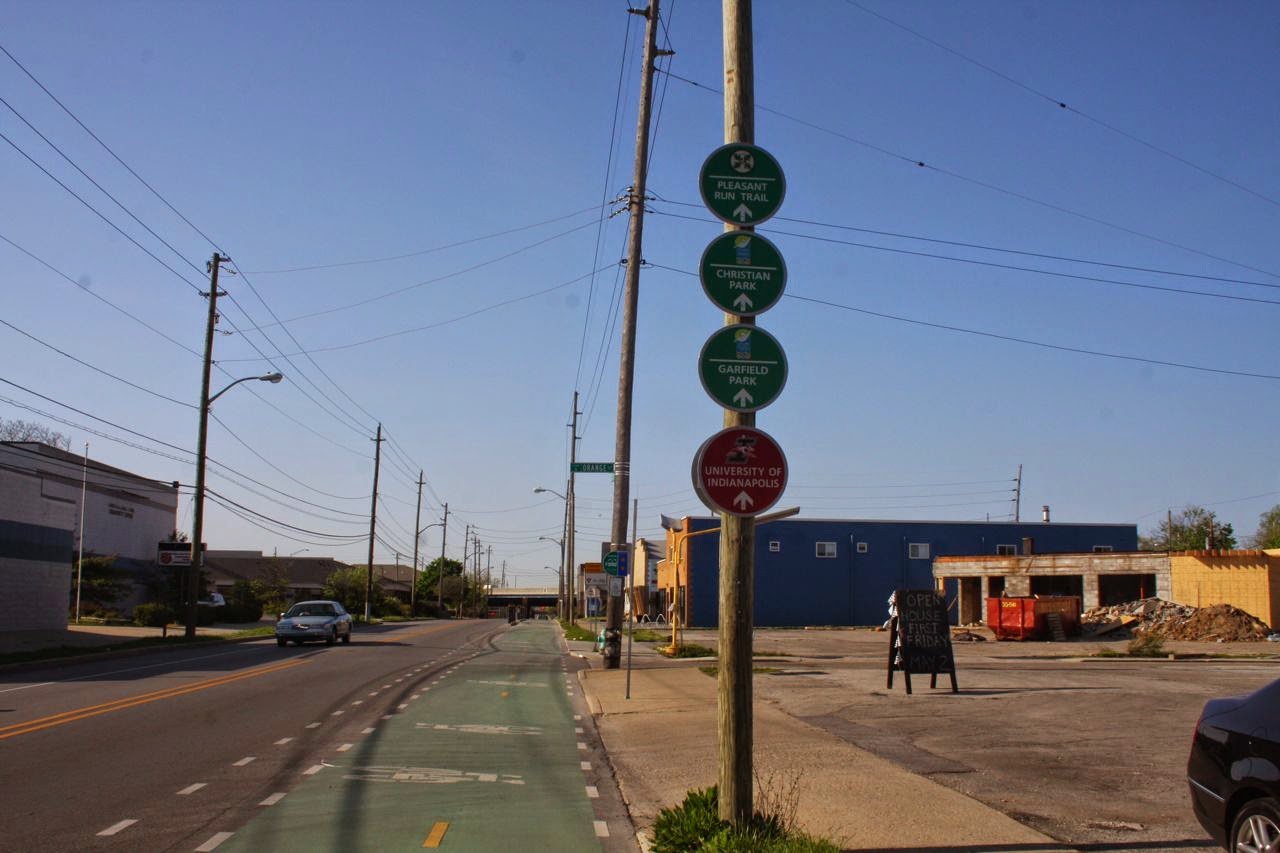
Connects with this cycle track at the south end, which then leads to a greenway


 Monon Trail at the north end


Bike fix-it station